Japan Foundation Conferred 41st PJS Medal of Merit

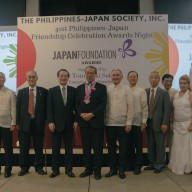
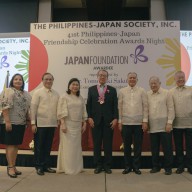
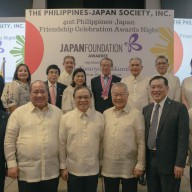
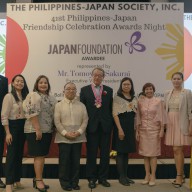
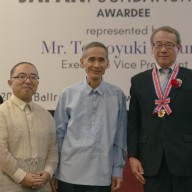
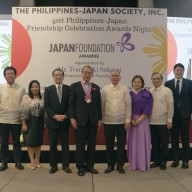
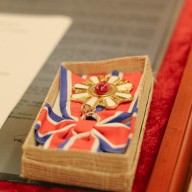
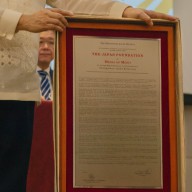
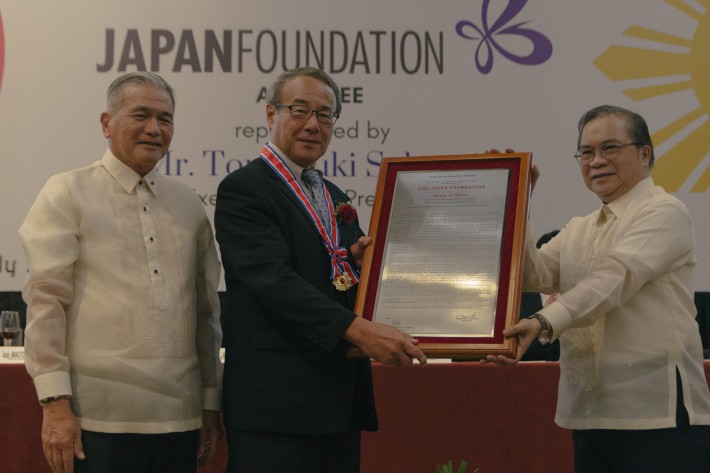
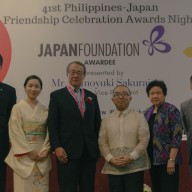
On July 31, 2019, The Philippines-Japan Society (PJS) conferred upon The Japan Foundation (JF) the 41st Medal of Merit for outstanding achievements and contributions in promoting and strengthening Philippines-Japan relations. During the formal awards night held at the New World Hotel in Makati City, PJS President, Mr. Francis C. Laurel and Vice-President, Mr. Gerard B. Sanvictores, donned the Medal of Merit to The Japan Foundation, represented by Executive Vice-President, Mr. Tomoyuki Sakurai and presented the plaque of the Citation, which was read by  Atty. Jose Vicente E. Jimenez, PJS Corporate Secretary.

The Japan Foundation was established on October 1972. The foundation remains to be the only institution dedicated to carrying out cultural and intellectual exchanges between Japan and other nations worldwide. Its programs focus on three areas: 1. Arts and Cultural Exchanges; 2. Japanese Studies and Intellectual Exchanges; and 3. Japanese Language Education Overseas. In 2014, it established The Japan Foundation Asia Center—a special unit aimed at furthering cultural exchange between Japan and Southeast Asia. In 1996, Japan Foundation Manila (JFM) was established as its 18th overseas office.

Since 1997, JFM has been a close and active partner of the Philippine Institute of Japanese Language & Culture Foundation (PIJLC) and Nihongo Center Foundation (NCF) specifically in the field of Japanese language education and training. PIJLC and NCF operate under the aegis of The Philippines-Japan Friendship Foundation (PJFF), an affiliate of PJS. One notable, long-running collaboration has been the 6-month Intensive Japanese Language Program for Filipino Nurses and Care Workers under the Japan-Philippines Economic Partnership Agreement (JPEPA) program. Filipino Nihongo teachers under PIJLC and NCF have also received grants and participated in training programs at the foundation’s offices in Urawa and Kansai. 

As stated on the MOM citation:

“Indeed, the vision, mission, and advocacy of the Philippines-Japan Society and all its affiliated Philippines-Japan friendship associations, including both the PIJLC and NCF, are markedly aligned with those of The Japan Foundation, making us natural partners in our shared quest for peace, prosperity, and strong partnership between our two countries through genuine and close friendships between the peoples of Japan and the Philippines.”

Read the full Citation of the Medal of Merit presented to The Japan Foundation here.

In his acceptance speech, Mr. Sakurai conveyed how the foundation is greatly honored by the recognition and how he feels that the relationship between Japanese and Filipinos is at its golden age— its closest and friendliest ever.

“…on behalf of The Japan Foundation, l would like to express our sincere gratitude to the Philippines-Japan Society for awarding us with such a prestigious medal of merit.”

“…the conferment of this medal of merit would not have been possible without the enormous contribution of many highly-capable and talented Filipino staff members since the establishment of The Japan Foundation, Manila in 1996.”

“I feel that the present relationship between Japanese and Filipinos is at its closest and friendliest ever. We are blessed with a golden age in Japan-Philippines relations.”

Read the full acceptance speech of Mr. Sakurai here.


Ambassador Makoto Katsura, President of The Philippine Society of Japan, spoke at the awards night, while the greetings of H.E. Koji Haneda, Ambassador Extraordinary & Plenipotentiary of Japan to the Philippines were read by Minister Atsushi Kuwabara, Minister and Consul General of Japan in the Philippines. The Philippines-Japan Ladies Choral, led by Maestra Teresita A. Santos,  delighted the guests with their medley of Filipino and Japanese songs. 
 

———————

Resources:

Citation of the Medal of Merit
Acceptance Speech by Mr. Tomoyuki Sakurai
Opening Remarks by Mr. Francis C. Laurel
Greetings by Amb. Koji Haneda (read by Minister Atsushi Kuwabara)
Program
Photo Gallery


PHILJEC Adviser Mr. Feliciano Torres Conferred Order of the Rising Sun, Gold Rays with Neck Ribbon

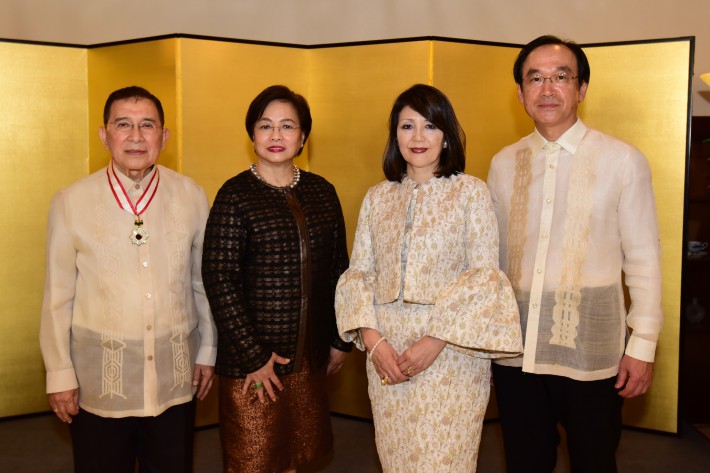
Ambassador Koji Haneda on behalf of His Majesty the Emperor of Japan conferred upon PHILJEC Adviser and PJS Medal of Merit Awardee, Mr. Feliciano Torres, The Order of the Rising Sun with Neck Ribbon in an awarding reception held on January 10, 2019 at the Japanese Ambassador’s Residence. The Imperial Award was given in recognition of Mr. Torres’ valuable contributions to Japan’s economy and automobile industry being the President of Yazaki Torres Corporation, the country’s number one exporter of automotive parts for more than three decades.

In his acceptance speech, Mr. Torres expressed his gratitude to the people and organizations whom he has worked with throughout the years. These included the Late Ambassador Jose S. Laurel III, Mr. Gregorio Uy Lim of UE Automotive, and his father and role model, Mr. Antonio T. Torres.

Mr. Torres also emphasized that for 45 years, Yazaki-Torres Manufacturing has maintained industrial peace by being fair to its people. “When I am asked what is the strength that leads to success, my answer is always this—the discipline, determination, and unity of our company’s human capital—our people,” Mr. Torres said. “In this light, to be conferred The Order of the Rising Sun, Gold Rays with Neck Ribbon, among many deserving, is a milestone not just for myself or our companies, but for our employees, our partners and for all of us that strive to cultivate and strengthen Philippine-Japan relations.”

In his speech, Ambassador Haneda praised the personal philosophy of Mr. Torres—his belief in kokoro to kokoro no fureai or heart-to-heart relationship founded on mutual trust and respect. He also mentioned the vital role Mr. Torres had in crafting the Japan-Philippines Economic Partnership Agreement (JPEPA). “Mr. Torres viewed JPEPA as a vital economic measure for Japan and the Philippines to rev up our cooperation and open a wide range of opportunities that would ultimately cascade to our industries. True enough, his steadfast commitment to this cause still redounds to the dynamic exchanges being enjoyed by our automobile sectors to this day,” said the Ambassador.

From 1998 to 2000, Mr. Torres served as Chairman of PHILJEC and led dialogues on economic, cultural, and business development between Japan and the Philippines. He led and represented the position of the automobile industry of the Philippines during the crafting and development of the JPEPA.

Resources:


PJS Holds 41st Friendship Golf Tournament with Highest Number of Players and First All-Ladies Team

Held on February 20, 2019 at The Country Club in Sta. Rosa, Laguna, this year’s 41st PJS Friendship Golf Tournament recorded its highest number of players—80 to be exact—and its first all-ladies team making it an extra special and historical event. The players started arriving as early 5 a.m. to register and prepare for the tournament, which opened with a ceremonial group photo taking before players headed to their respective holes.

“All 72 planned slots were filled up as early as 2nd week of January, which resulted to the Golf Committee opening additional slots to accommodate the strong demand to participate in the tournament,” explained Mr. Joseph Uy, PJS Golf Committee Chairman. “It is also our first year to have an all-ladies team. We usually average only 25 to 30 players all men players in the past,” he added. This year’s all-ladies team was composed of May Uy (Sinag Solutions, Inc.); Hiromi Shimoda (BDO Unibank, Inc.); Masumi Tago (Marubeni Philippines); and Yuko Iyori (Embassy of Japan).

The tournament format was a Scramble (Best Ball) honesty game made up of four-man teams with at least one Filipino or one Japanese member. Each team played alone with no one checking Team scores. Special tournament rules and regulations made the tournament exciting and special strategies required the team to study their individual member’s strengths and weaknesses in order to get the best team scores.  Overall, cooperation between all team members was required to win.

Team 18 under the leadership of team captain, Amon Rivera, was declared overall champion with a net 68 which included an eagle on the par 5 Hole Number 10. Team 10B of Fumihiko Harada was the 1st Runner-up with a net score of 69 followed by the 2nd Runner-up team 10A led by Roberto Anonas, Jr. with a score of net 70.  

Fun Hole prizes were also awarded during the tournament:

  • Longest Drive: Hole #2 – Ishikawa Toshiyuki, 253 yards
  • Longest Drive: Hole #8 – Nobuyuki Ariyoshi, 275 yards
  • Nearest to the Pin: Hole #11 – Fumihiko Harada, 137 inches
  • Nearest to the Pin: Hole #6 – Masahiro Makino, 26 cm

For detailed results and photos of the event, refer to our Resources.


Fukuda Doctrine Commemorative Marker Unveiled at Manila Hotel

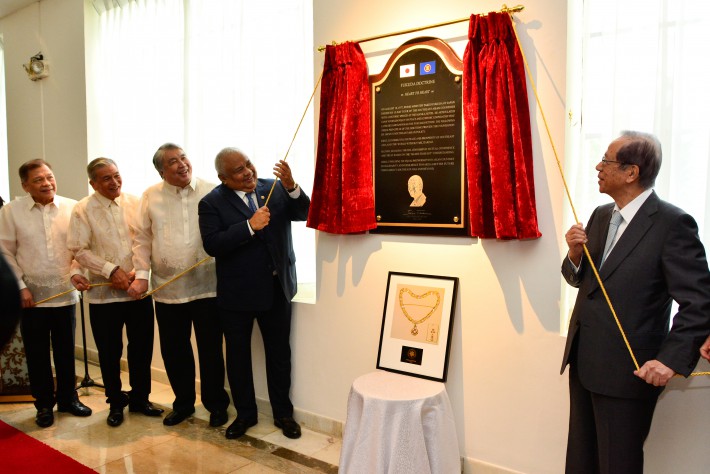
In celebration of the 40th year of the Fukuda Doctrine, representatives from Japan and ASEAN gathered at the Manila Hotel on October 1, 2018 to witness the unveiling of the Doctrine’s Commemorative Marker spearheaded by The Philippines-Japan Society. After the unveiling, a symposium was also held at the Fiesta Pavilion where the Doctrine was first pronounced by the late Prime Minister Takeo Fukuda on August 18, 1977.

Former Prime Minister Yasuo Fukuda, son of PM Takeo Fukuda, was present to personally lead the unveiling ceremony. He was accompanied by other special guests: Japanese Ambassador to the Philippines Koji Haneda, Executive Secretary Salvador C. Medialdea, Philippines-Japan Society President Francis C. Laurel, Acting Secretary of Foreign Affairs Jose Luis G. Montales, and Philippine Ambassador to Japan Jose C. Laurel V.  

Speakers for the symposium that morning were Dr. Ginandjar Kartasasmita, Chairman of the Indonesia-Japan Friendship Association; Ambassador Delia D. Albert, former Secretary of Foreign Affairs of the Philippines; and Dr. Mie Oba, Professor of Tokyo University of Science. Dr. Kartasasmita presented a historical perspective on the Fukuda Doctrine while Amb. Albert talked about ASEAN-Japan-Philippines Relations, and Dr. Oba gave insights on the future relations between ASEAN and Japan.

Since its pronouncement in 1977, The Fukuda Doctrine has served as the blueprint for Japan’s foreign policy towards ASEAN. It has 3 key principles:

  • Japan is committed to peace and rejects the role of a military power;
  • Japan will consolidate the relationship of mutual confidence and trust based on “heart-to-heart” understanding among peoples of Japan and Southeast Asia; and,
  • Japan will cooperate positively with ASEAN [the Association of Southeast Asian Nations] while aiming to foster a relationship based on mutual understanding with the countries of Indochina and will thus contribute to the building of peace and prosperity throughout Southeast Asia.

The Fukuda Doctrine Commemorative Marker was designed at the instance of The Philippines-Japan Society by Filipino scholars of the Japanese Government studying at the University of the Philippines, Los Baños.

======

Resources:


PJS to Co-host Symposium on the Fukuda Doctrine & Installation of Commemorative Marker

The Philippines-Japan Society will co-host together with The Embassy of Japan in Manila a Symposium on the Fukuda Doctrine on October 1, 2018 at the Manila Hotel. The Symposium is envisioned to be a forum for reflecting the past, present, and future ASEAN-Japan partnership and the contribution of the Fukuda Doctrine thereto.

Also highlighting the event is the installation of a commemorative marker in the Manila Hotel, where the Fukuda Doctrine was first pronounced by then Prime Minister of Japan, Takeo Fukuda, in August 18, 1977. The doctrine serves as a guiding principle of Japan’s foreign policy towards the ASEAN and has positively impacted ASEAN-Japan relations in the past four decades. Last year, PJS met with PM Fukuda’s son, Yasuo, himself a former Prime Minister of Japan, on the significance of the doctrine.

The Symposium will feature prominent speakers who will share thoughts and insights into the foundations, the current state and the future prospects of ASEAN-Japan relations through the prism of the Fukuda Doctrine.


Page 4 of 16First...345...Last
RSS
Facebook
LinkedIn

Archives