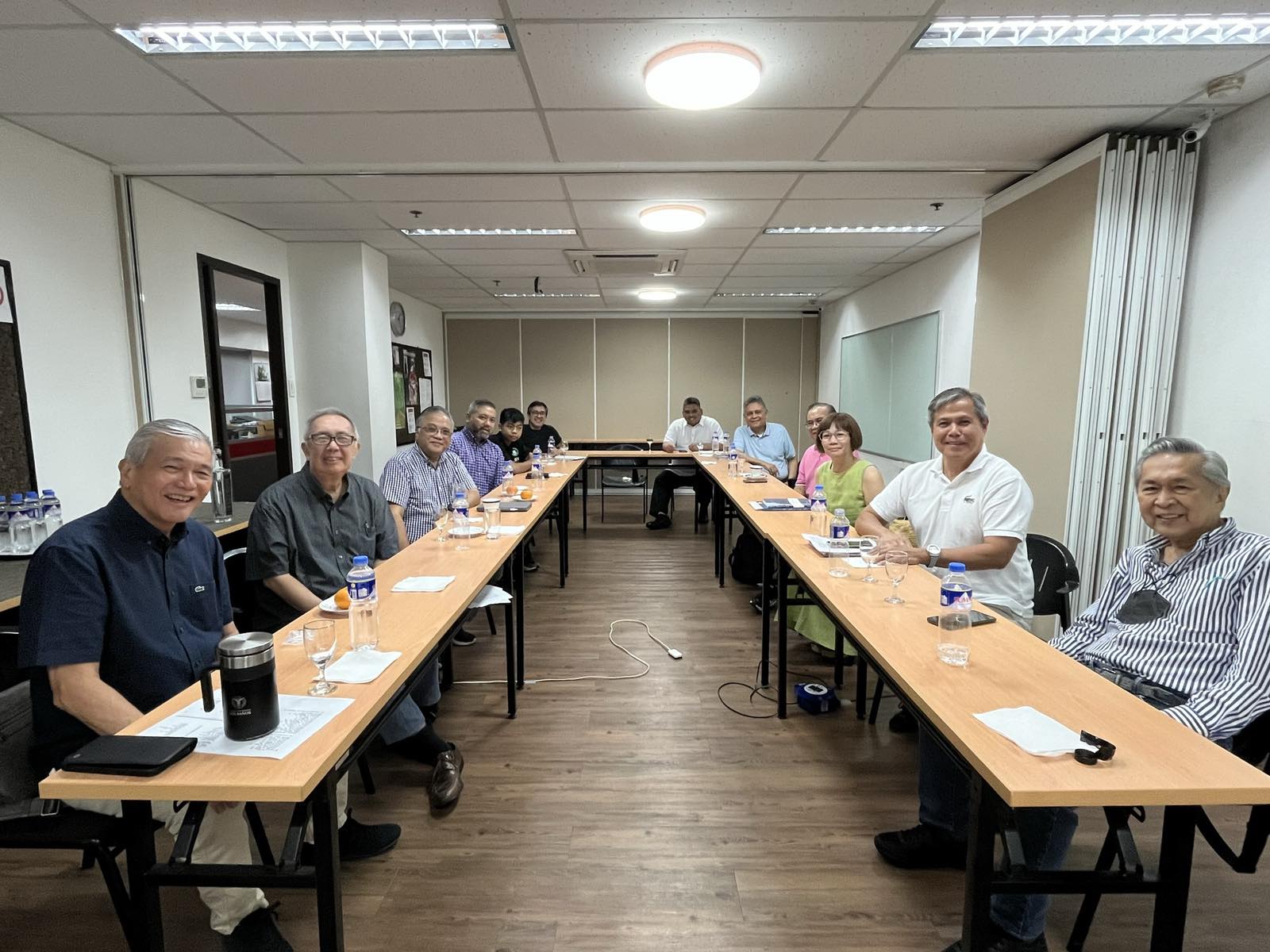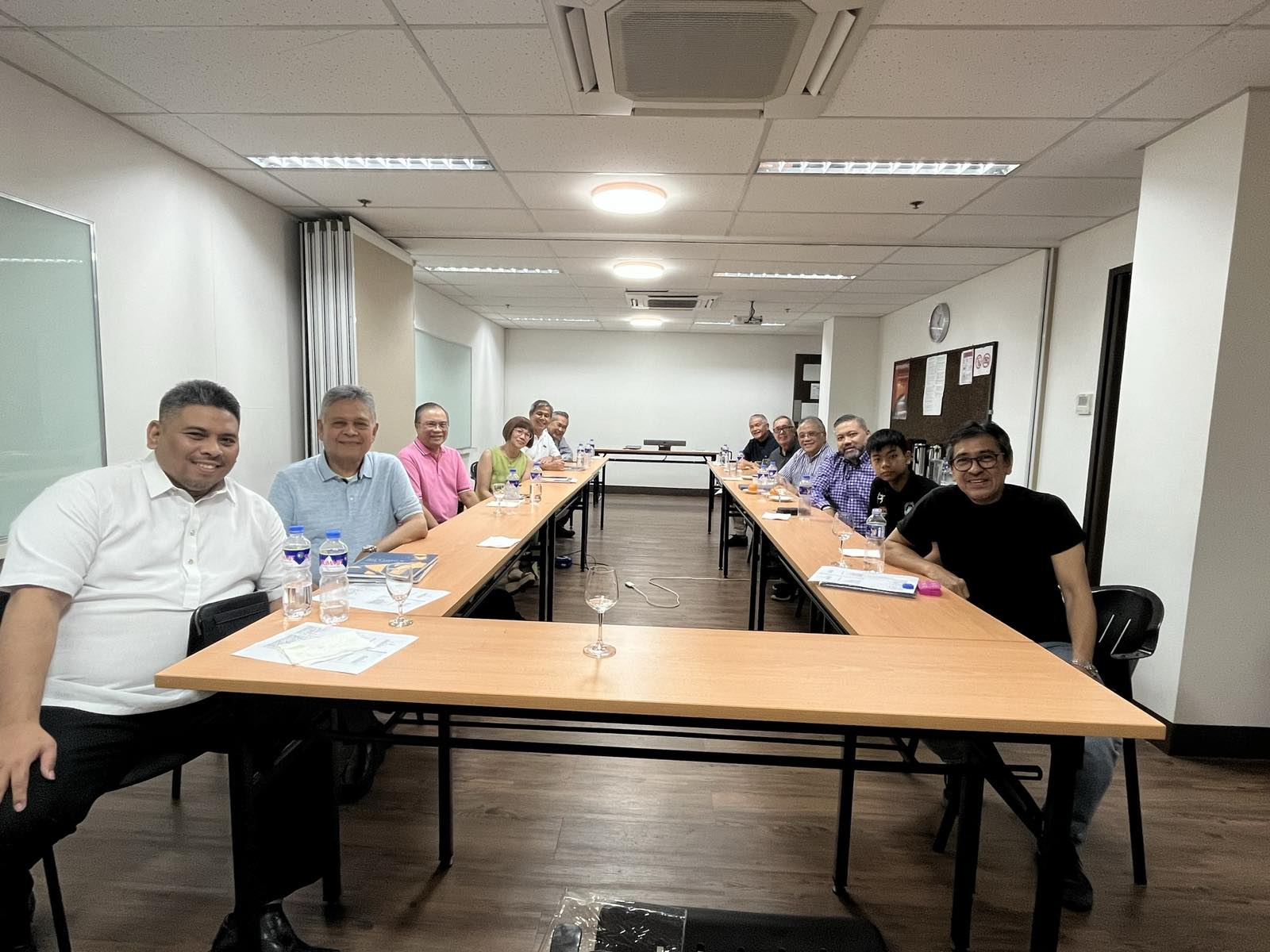
JAPAN EMBASSY AND PHILFEJA HOST 2024 SHINNENKAI

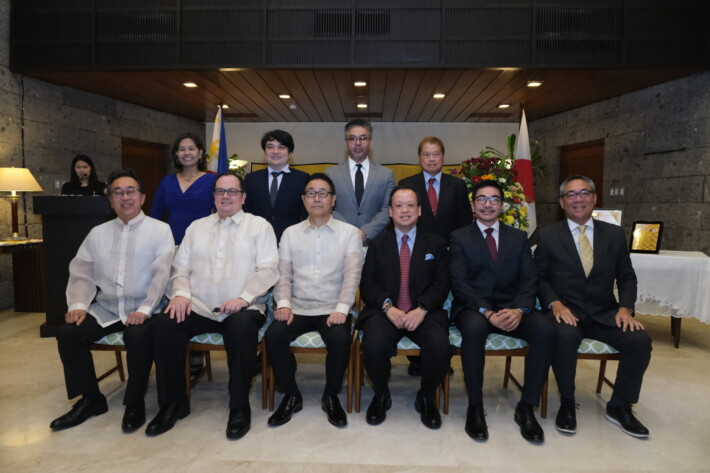
The Embassy of Japan and the Philippine Federation of Japan Alumni (PHILFEJA) held its annual Shinnenkai on 02 February 2024 at the official residence of Japan’s Ambassador to the Philippines, with Ms. Jalenie Chua of the Embassy of Japan as the Master of Ceremonies.

Distinguished guests graced the event including, among others, Cultural Center of the Philippines Chairman and Former Minister of Education, Culture, and Sports of the Philippines Jaime C. Laya, Philippine Competition Commission Chairman Atty. Michael G. Aguinaldo, JICC Director Shigehiro Matsuda, JICA Philippines Chief Representative Takema Sakamoto, Marubeni Corporation Philippines President (and The Japanese Chamber of Commerce and Industry of the Philippines President) Shigeru Shimoda, and Asst. Sec. Mario Zinampan of the Department of Migrant Workers.

The evening started with cocktails, with the attendees exchanging warm greetings, sharing experiences of the past year and expressing hopes and aspirations for the year ahead.

Following the cocktails, the program proper started.  Ambassador Kazuhiko Koshikawa, delivered a message, citing the friendship and cooperation between the two countries.  He spoke fondly of the ASEAN Council of Japan Alumni (ASCOJA) as PHILFEJA President Domingo Go was one of the people who attended “Study in Japan Forum ASEAN” in Tokyo last November 2023 and how ASCOJA has been a pivotal support for strengthening the bilateral relations between Japan and ASEAN as a whole.  Moreover, he described how the relationship of Japan and the Philippines evolved throughout the years and pointed out that it has now resulted in security cooperation and close economic ties.
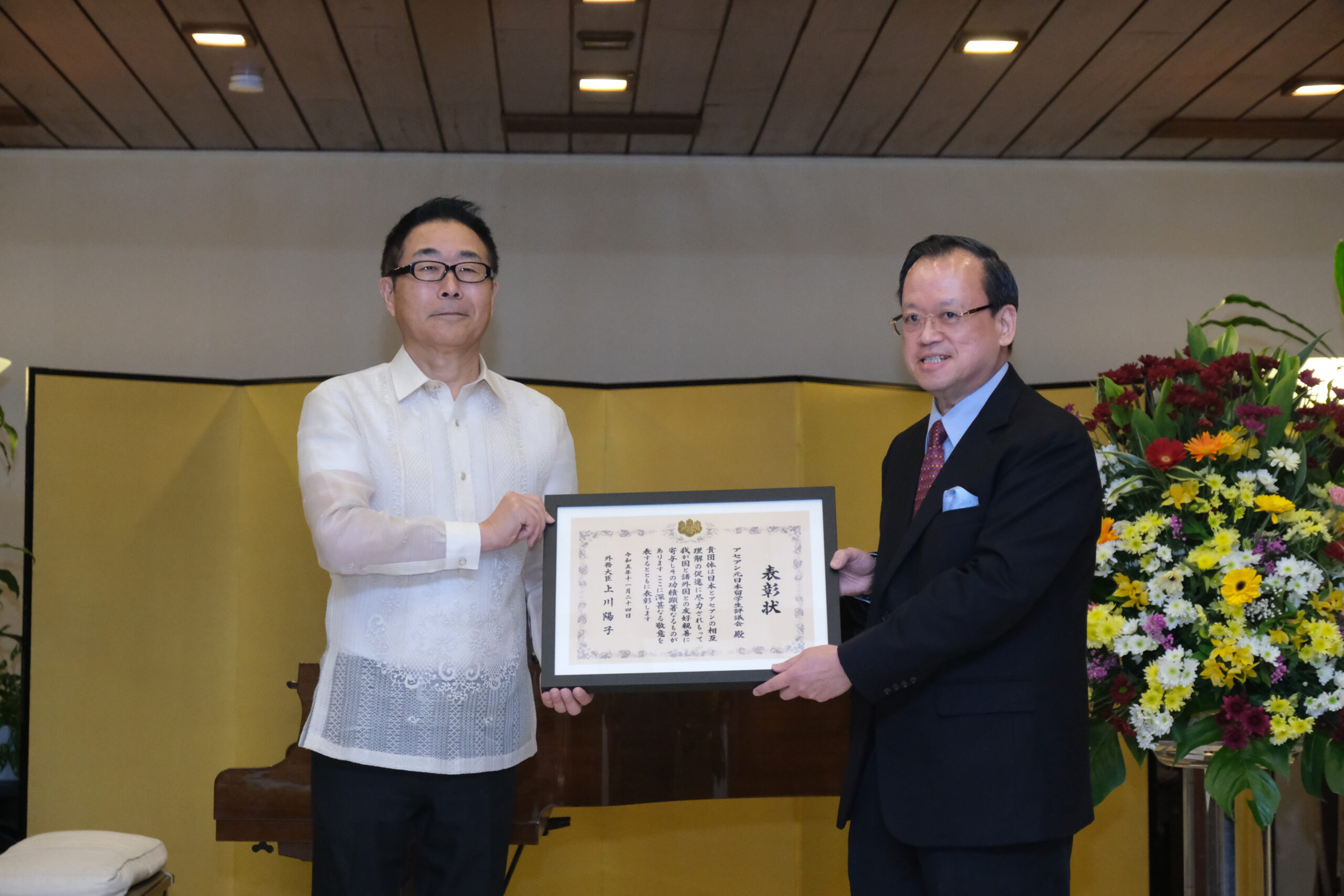
“In receiving this recognition, I cannot help but recall our student days – a common experience I am certain many of us present tonight share: the difficulties and challenges we faced as we labored through our studies in a foreign land… In facing the challenges together, we developed a certain camaraderie and kinship amongst ourselves and with them that would last a lifetime.” (Read more)

In his remarks that followed, Mr. Go expressed PHILFEJA’s gratitude to Ambassador Koshikawa for allowing the Embassy of Japan to co-host the event at his elegant residence, and for presenting to PHILFEJA, as a founding member of ASCOJA, the Certificate of Recognition given by Japan’s Ministry of Foreign Affairs to ASCOJA.  Mr. Go then recalled the common experiences faced by students who studied in Japan – and how these have led to friendships with students from Japan and other countries.  He pointed out that this spirit of kindship and camaraderie is widespread throughout all of the Japan alumni organizations in ASEAN, as all members of ASCOJA share a common thread with Japan, giving impetus to these friendships and spirit of collaboration.  While emphasizing that these experiences have significantly influenced the lives of the alumni and have served to shape their bond with Japan – a bond that needed to be nurtured and sustained – he then called on all alumni to ensure that the future generations will appreciate and understand the importance of sustaining this bond.
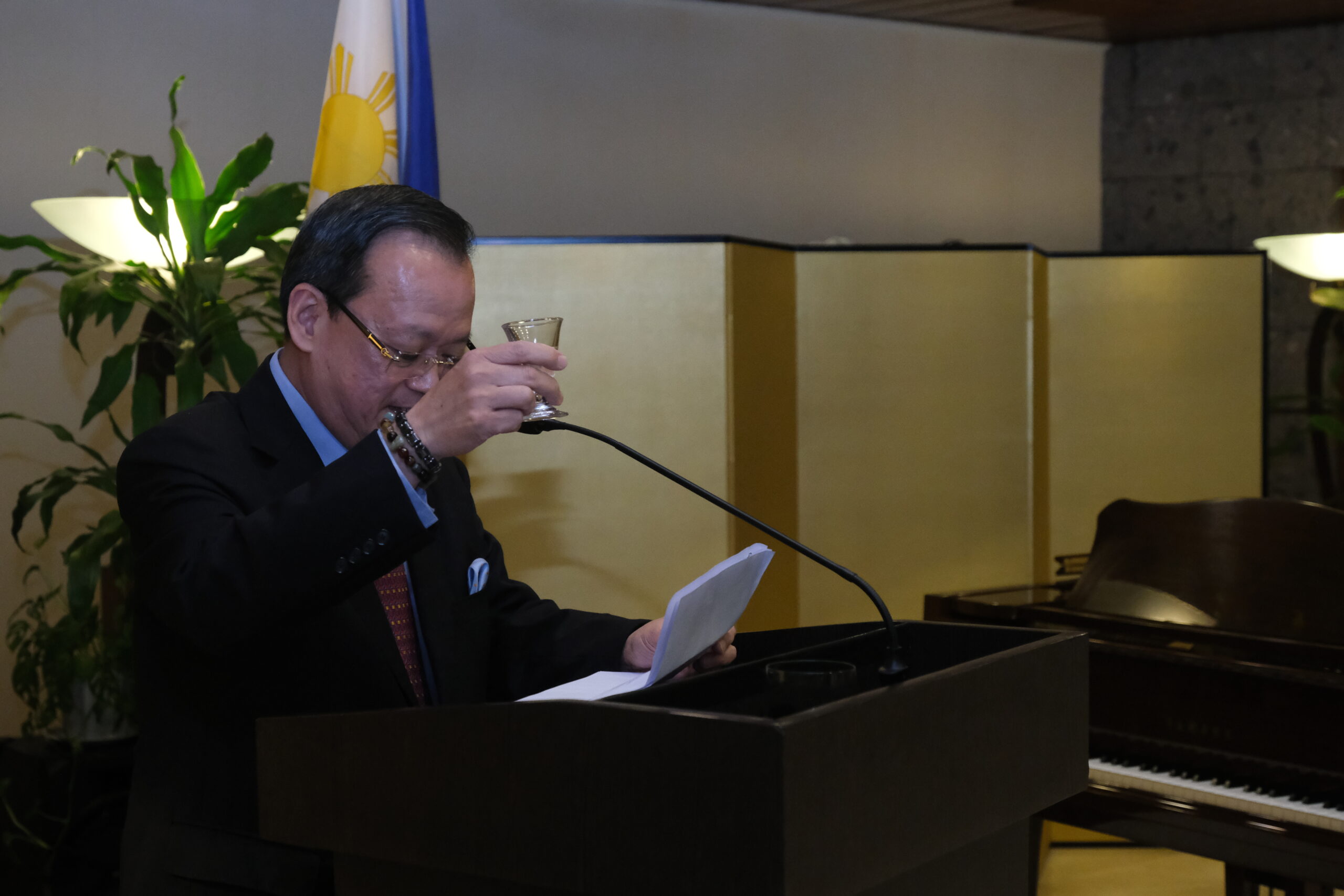
He ended his remarks by inviting everyone to join him in a toast to the further deepening of this friendship and camaraderie and to the continued success of PHILFEJA.

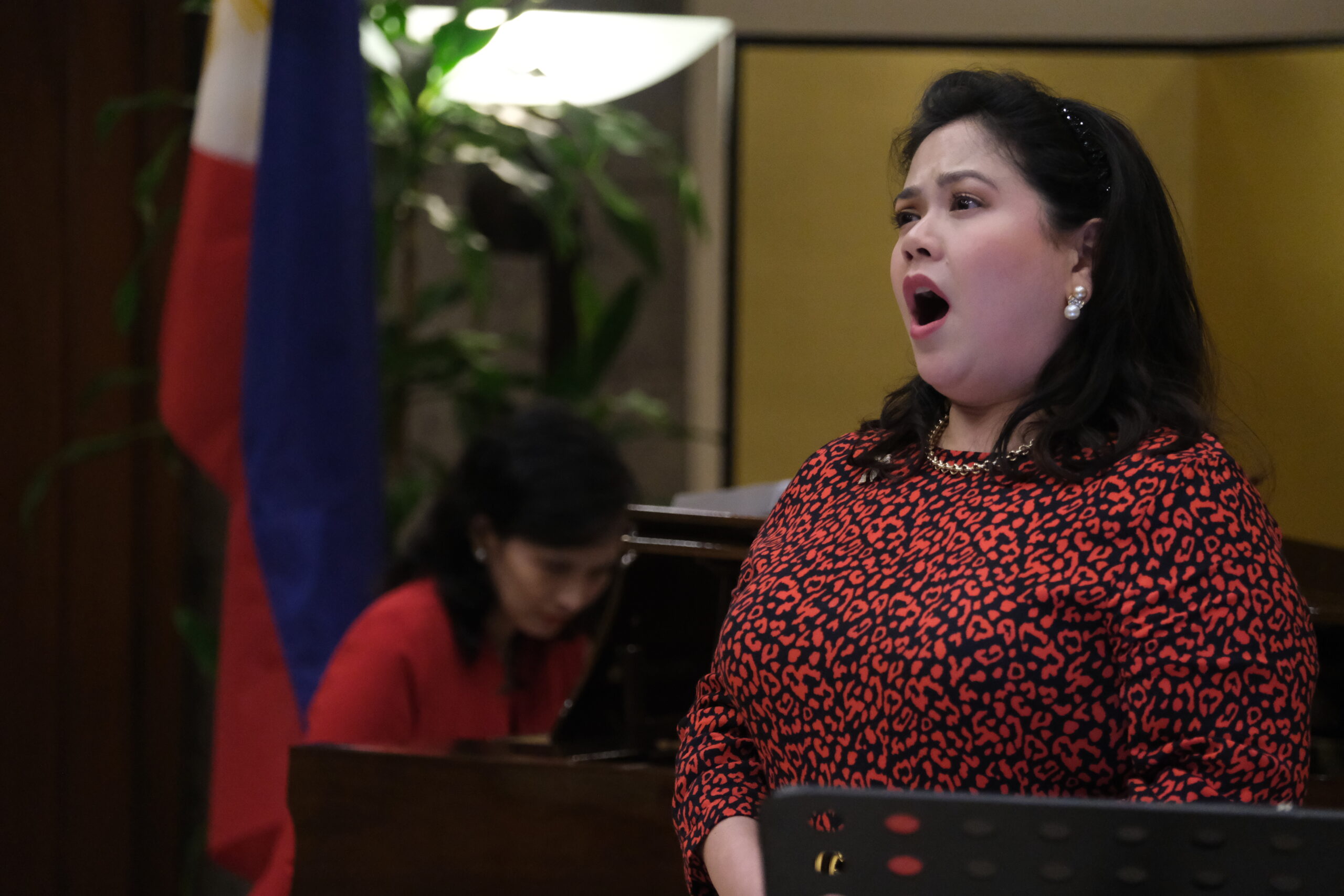
After the toast, Pianist Mariel Ilusorio and Soprano Anna Migallos regaled the audience with Gaano Ko Ikaw Kamahal, If I Loved You, All the Things You Are, Somewhere Over the Rainbow and Hana wa Saku.  She also sang Quando M’en Vo from Puccini’s La Bohème as the encore number.

Finally, a photo session was also held commemorating the joyous occasion.

It was a truly memorable event, a first in the 47-year history of PHILFEJA.
Resources

Ambassador Koshikawa’s Speech
Mr. Domingo Go’s Speech
Photos


PJS hosts its 43rd Philippines-Japan Friendship Golf Tournament

Last January 17, 2024, the Philippines-Japan Society, Inc. (PJS) held its 43rd Golf Tournament at the Wack Wack Golf & Country Club, Mandaluyong City. 

With 111 players participating, it broke the record of the highest number of players to attend in the history of the organization’s golf tournament. The Ceremonial Tee Shot officially kicked off the competition followed by the shotgun starts of every flight at their respective assigned holes. The players were divided into 28 groups with four members each, switching turns in a Scramble Best Ball honesty game. 

Team 6 composed of JJ Atencio, Paolo Cagalingan, Masatoshi Saito, and Keishi Saito bagged the victory with a gross score of 65, a handicap of 19, and a net score of 46. Filemon Del Carmen, Alfredo Del Carmen, Michael Del Carmen, and Yasunori Takamatsu of Flight 11 took 1st runner up with 67 gross score, 20 handicap, and 47 net score. For 2nd runner up, Harutaka Ishikawa, Yasuhiro Fukuki, Edwin Umali, and Shinichi Kusunoki’s team garnered a gross score of 69, handicap of 22, and net score of 47.

Fun holes were also awarded to the following:

Nearest to the Pin: Hole #8 – Takao Shinohara, 4 ft

Nearest to the Pin: Hole #14 – Ichirou Iwabuchi, 1 ft

Longest Drive: Hole #13 – Joel Aguada, 300 yards

Most Accurate Drive: Hole #13 – Toshiaki Fujioka, 1 ft

Golf Committee Chairman Ramon Maria Abaquin announced his retirement from the committee at the awards ceremony and introduced the new members: Atty. Carrie Bee Hao, Mr. Archie Sanvictores, Mr. Tomohiro Koseki, and Mr. Kunihiko Nimura.

Resources:
Photos


HOW TO ACCESS THE JLPT ONLINE RESULT

DECEMBER 2023: HOW TO ACCESS THE JLPT ONLINE RESULT

Online Result Viewing
Start: January 22, 2024 at 9:00 AM (Philippine Time)
End: March 31, 2024 at 4:00 PM (Philippine Time)

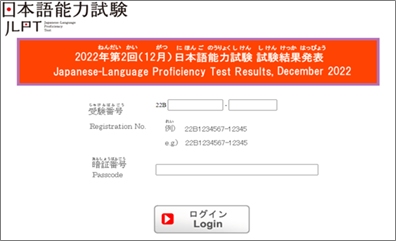
• Go to the link < https://www.jlpt-overseas.jp/onlineresults/preinput.do >. You will be directed to the Log-in page. Refer to Image A for the sample log-in page.
Note: The online result viewing will be accessible ONLY during the given time period.

Image A: Log-in Page

• Fill out the necessary fields (1) Registration Number and (2) Passcode, then click the Login button. The registration number and passcode can be found in your test voucher. Location of registration number and passcode is shown in Image B.
Note: You can download the digital copy of the test voucher in your JLPT Account (Guide: https://bit.ly/45nqvVm).

Image B: Test Voucher

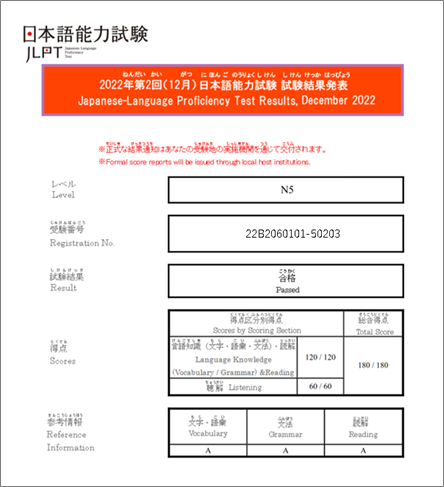
  • After you log in, the page will immediately show the score report. The score report only shows the level, registration number, result, scores and reference information. A sample result is shown in Image C. All of the information will appear on the official printed score report with other additional information.
    Note: The official Certificate of Japanese-Language Proficiency (for passers) and Score Report (for all examinees) will arrive in the Philippines around the last weeks of February 2024.
Image C: Online Score Report Page

Important Reminder:
JLPT Online Result can be viewed multiple times within the given time period.
The page will not be accessible after 4:00PM of March 31, 2024.

– Nothing to follow –


PHILJEC celebrates 50th Foundation Anniversary

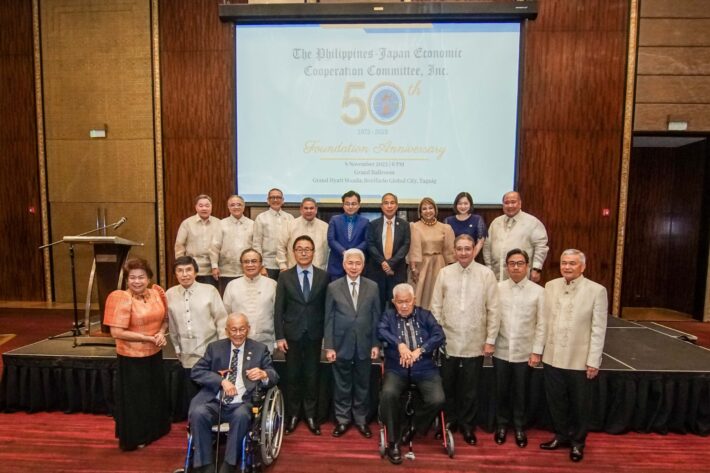
On November 8, 2023, the Philippines-Japan Economic Cooperation Committee, Inc. (PHILJEC) commemorated its 50th Foundation Anniversary with a grand celebration at the Grand Hyatt Manila in Bonifacio Global City, Taguig.

Guests were warmly welcomed into the Grand Ballroom by PHILJEC officials: Chairman Richard Albert I. Osmond, Co-Chairman Alfred V. Ty, and Co-Chairman Ferdinand A. Ferrer. The evening began with cocktails, followed by a formal reception. The venue was adorned with congratulatory flower stands from ten PHILJEC trustees and President Shigeru Shimoda of the Japan Chamber of Commerce and Industry of the Philippines, Inc. (JCCIPI), reflecting the strong support from both Filipino and Japanese stakeholders.

Chairman Osmond opened the program with his welcome remarks, setting the tone for the evening. He was followed by messages from distinguished guests: H.E. KOSHIKAWA Kazuhiko, Ambassador Extraordinary & Plenipotentiary of Japan to the Philippines, and Mr. Francis C. Laurel, former PHILJEC Chairman (2005-2008). 

In his speech, Mr. Osmond reflected on the deep-rooted history of Philippines-Japan relations, stating, “…the friendship and business cooperation between Japan and the Philippines started way beyond 50 years ago. The bigger interesting challenge is the next 50 years ahead as the world is drastically changing in terms of its climate, economic and business landscape, and culture.”

Ambassador Koshikawa expressed his hopes for the continued strengthening of bilateral ties, emphasizing PHILJEC’s role in fostering collaboration. “I do hope that as PHILJEC continues its legacy, more and more Japanese companies will create lasting impact on the Philippine society. Together, we will strengthen and take advantage of our Golden Age of partnership, fifty years and beyond,” he said.

Mr. Laurel highlighted the growing synergy between the two nations and PHILJEC’s pivotal role in nurturing this relationship. “Our efficiency and effectiveness has been proven through the years. The leadership of PHILJEC is remarkable and outstanding. It is therefore with great pride that we all celebrate PHILJEC’s 50th anniversary,” he remarked.

Video messages from Her Excellency Mylene J. Garcia-Albano, Ambassador Extraordinary and Plenipotentiary of the Philippines to Japan, and Mr. HIRAKO Yuji, Chairman of the Japan-Philippines Economic Cooperation Committee, were also shared during the program.

Co-Chairman Ferrer led a celebratory toast, followed by dinner and a musical performance by the LG Strings Trio. Guests were treated to a commemorative video showcasing PHILJEC’s milestones, past chairmen, and joint meetings — highlighting the organization’s rich history and achievements.

The event was concluded with closing remarks from Co-Chairman Ty, who expressed his gratitude to Japan and its people for their friendship with the Philippines and the Filipinos. At the end, he said, “Our journey of economic cooperation has come a long way. I am confident, however, that even better days lie ahead for our relationship. I thank the Japanese people for extending their hand of friendship and I know we, Filipinos, will continue to extend our hand, too. As we look ahead, I believe that our enduring ties of the last 50 years will become only stronger and deeper.”

Welcome Remarks of Mr. Richard Albert I. Osmond
Message from H. E. Mylene J. Garcia-Albano
Message from H. E. KOSHIKAWA Kazuhiko
Message from Mr. HIRAKO Yuji
Message from Mr. Francis C. Laurel
Closing Remarks of Mr. Alfred V. Ty


NANTOKU Descendants

Unknown to many, there was a unique student group that was sent to Japan during the war, known as the “Nampo Tokubetsu Ryugakusei” 南方特別留学生(translated: Special Foreign Students from the Southern Regions) – “Nantoku” for short. There were two batches of Filipino Nantoku – the first consisted of 10 constabulary officers and 17 civilian students, with ages ranging from 15 to 23 who landed in Japan on July 17, 1943; the second group of 24 young men, also in their teens and early 20’s followed in  June 1944.  All told, there were 51 Filipino Nantoku, out of around 200 young Asians who were selected from the occupied territories to study in Japan under the vaunted “Nampo Tokubetsu Ryugakusei” Program.

It was sometime in mid-1942 when Japan’s wartime Greater East Asia Ministry (大東亜省) was tasked to recruit and train young men from the occupied territories of Borneo, Siam, Java, Sumatra, Burma, Anam and the Philippines. Known as ‘pensionados or scholars of the Japanese government, the Filipinos and their classmates from Southeast Asia, learned the Japanese language and were taught Japanese culture, history, customs and traditions.  They were to be groomed as future leaders under Japan’s Greater East Asia Co-Prosperity Sphere (“Daitoa Kyoueiken” 大東亜共栄圏) colonial policy.

The Program was dissolved at the end of the war in 1945, and the Filipino pensionados returned home to resume their lives as students and young professionals with a strong desire to contribute to the country’s reconstruction.  They eventually rose to prominence in public service, politics, the military, business and industry, the academe and the like.  The Filipino Nantoku attributed their successes in no small measure to their education in Japan and first-hand exposure to Japanese life, especially during the war.  While narratives of war generally point to atrocities, death, destruction and all its horrific consequences, the Nantoku experience in Japan was punctuated by the many kindnesses, courtesies, hospitality and care extended to them by ordinary Japanese in the midst of the war.

As they became leaders in their respective fields, the Nantoku were instrumental in nurturing closer postwar relations between the Philippines and Japan, both at the  professional and personal levels.  Meanwhile, the Japanese Government launched the Monbusho Scholarship Program in 1954[1], whose precursor was the wartime Nantoku Program.

In 1976, the Filipino Nantoku group spearheaded the establishment of the Philippine Federation of Japan Alumni which, in March 1977 was among the Charter associations that founded the ASEAN Council of Japan Alumni. In August 1977, the Fukuda Doctrine was proclaimed.

The exceptional bonds that tied the Filipino Nantoku traced from the war years, as well as with their fellow-Nantoku from Southeast Asia during the war, continued throughout their lifetimes. They embodied bridges of reconciliation, understanding, mutual respect and friendship between their countries and their second home – Japan.

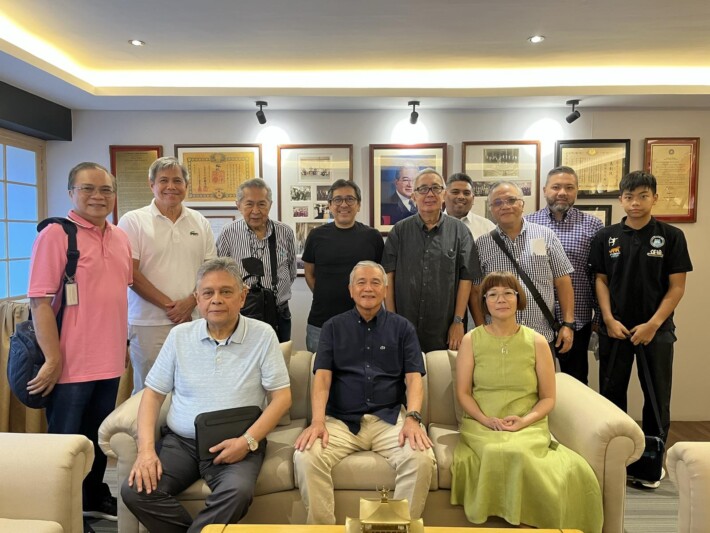
Born out of love for their fathers, the NANTOKU Descendants are organizing to trace and recognize the role of the Nantoku in Philippine history, and their passionate advocacy for the promotion of Philippines-Japan friendship after World War II. These descendants aspire to honor the memories of the Filipino Nantoku pensionados and continue their legacy of promoting friendship and understanding among the peoples of the Philippines, Southeast Asia and Japan, which the Nantoku bequeathed to generations after them.

Written by Gary Alba and Philip Sanvictores
October 2023


[1] Now known as the Monbukagakusho Scholarship 文部科学省奨学金


Page 12 of 19First...111213...Last
RSS
Facebook
LinkedIn

Archives